Palmistry Central Lines: 3 Essential Lines To Read
Explore the meanings of your palm's three dominant lines and what they reveal about your life.
nn
Palmistry has long served as a method for individuals seeking self-discovery and personal insight. Among the countless markings on the human hand, three lines stand out as the foundation of palm reading practice: the heart line, the head line, and the life line. Each of these principal lines carries distinct significance in palmistry, offering practitioners a framework for understanding different aspects of human experience. Rather than predicting a fixed future, these lines function as mirrors reflecting personality tendencies, emotional patterns, intellectual inclinations, and the overall quality of one’s existence. For those beginning their journey into this ancient practice, understanding these three core lines provides an essential starting point for deeper exploration.
nn
The Foundation of Palm Analysis
nn
The practice of reading palms extends back centuries, rooted in various cultural traditions spanning from Asia to Europe and beyond. Modern palmistry synthesizes these historical approaches into a coherent system where specific anatomical features of the hand become meaningful indicators of human characteristics. The three major lines—heart, head, and life—form the scaffolding upon which comprehensive palm readings are constructed. These lines do not exist in isolation; rather, they interact and inform one another, creating a complex narrative about an individual’s psychological makeup, emotional landscape, and life trajectory.
nn
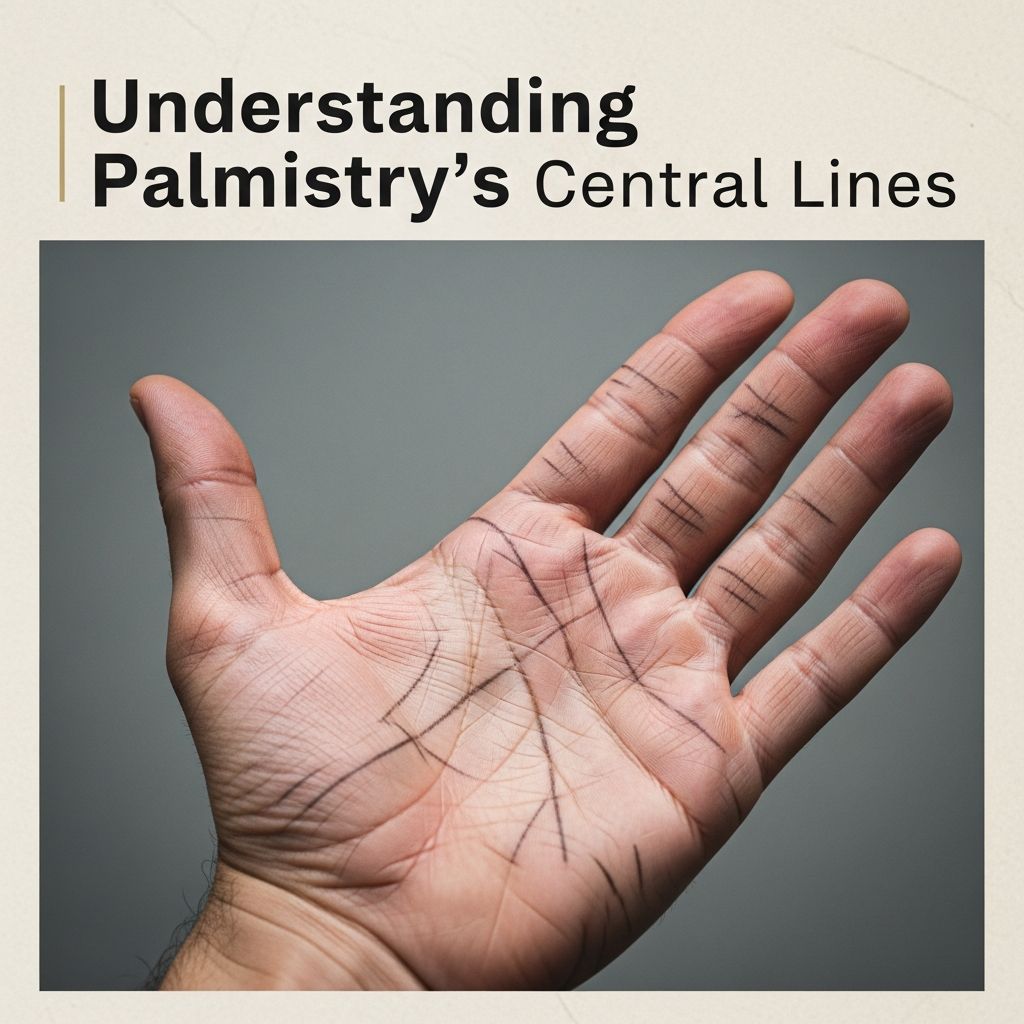
Understanding the positioning of these lines requires basic hand anatomy knowledge. The heart line occupies the uppermost position on the palm, running horizontally across the top portion of the hand. Below it sits the head line, also traversing the palm in a horizontal direction. The life line curves around the base of the thumb, extending toward the wrist. This spatial arrangement reflects a conceptual hierarchy in some interpretive traditions, with the heart line representing the realm of feeling and passion, the head line representing the domain of thought and reason, and the life line representing the physical vessel through which all experiences manifest.
nn
The Heart Line: Portal to Emotional Existence
nn
The heart line serves as a window into an individual’s emotional world, revealing patterns in how they experience, express, and process feelings. This line encompasses far more than romantic love; it represents the entire spectrum of emotional capacity, including compassion, empathy, vulnerability, and emotional boundaries. Individuals new to palm reading often find the heart line particularly relevant because it speaks directly to relationships—both with others and with oneself.
nn
The appearance and characteristics of the heart line vary significantly from person to person, and these variations carry interpretive weight. A deep and clearly defined heart line typically suggests someone with robust emotional awareness and the capacity for profound connection. Such individuals often demonstrate strong emotional expression and may find themselves naturally drawn to nurturing roles. Conversely, a lighter or fainter heart line might indicate someone whose emotional expression is more subdued or whose emotional energy feels diffused across multiple concerns.
nn
Variations in Heart Line Appearance
nn
- n
- Straight heart line: May suggest a more reserved or sensitive emotional approach, with careful consideration before emotional risk-taking
- Curved heart line: Often indicates someone who is emotionally expressive, romantic in outlook, and inclined toward demonstrating feelings openly
- Deep and clear: Suggests emotional stability and a capacity for lasting, meaningful connections
- Branches and forks: Can signify multifaceted emotional experiences, deep empathy, or potential emotional complexity
- Islands or circles: May indicate periods of emotional separation or temporary turmoil within relationships
- Breaks or disruptions: Could reflect challenges or transformative moments within one’s emotional life
n
n
n
n
n
n
nn
The endpoint of the heart line also carries significance. When a heart line terminates beneath the index finger, some practitioners interpret this as indicating a tendency toward idealism or potential disappointment in love. If it ends under the middle finger, this might suggest someone who prioritizes their own emotional needs. A heart line ending between these two fingers is sometimes read as indicating balance—an individual who can both honor their own emotional needs and consider those of their partners.
nn
The Head Line: Navigation System for Cognition
nn
Where the heart line reveals how we feel, the head line illuminates how we think—functioning as what some practitioners describe as the ”CPU” of the palm. This line represents intellectual processing, decision-making strategies, learning preferences, and the manner in which individuals engage with information and ideas. The head line serves as a crucial counterpoint to the heart line, representing the rational and analytical dimension of human consciousness.
nn
The head line’s configuration provides insight into cognitive style and mental patterns. A long, straight head line typically indicates someone with a methodical, logical, and analytical approach to problem-solving. Such individuals often excel in systematic thinking and may gravitate toward fields requiring precision and attention to detail. Their decision-making process tends to be deliberate and grounded in empirical reasoning.
nn
In contrast, a curved or sloping head line suggests enhanced creative and intuitive capacities. Individuals with this configuration often make decisions informed by a blend of logic and imaginative thinking, sometimes favoring instinct over strict analysis. These individuals might describe themselves as ”right-brained” thinkers, comfortable with ambiguity and skilled at synthesizing disparate ideas into novel solutions.
nn
Head Line Characteristics and Their Meanings
nn
| Head Line Feature | Interpretation |
|---|---|
| Long and straight | Logical, analytical, methodical thinking approach |
| Curved or sloping | Creative, intuitive, imaginative mental processing |
| Breaks or islands | Periods of mental stress, confusion, or significant mental transitions |
| Strong and unbroken | Clarity of thought, mental focus, and decisiveness |
| Short | Practical thinker, preference for concrete over abstract concepts |
nn
Disturbances in the head line warrant particular attention during readings. Breaks or island formations along this line are traditionally interpreted as indicating periods when mental clarity was compromised—perhaps during times of stress, confusion, or significant life transitions requiring substantial mental adjustment. A strong, continuous head line, by contrast, speaks to someone who maintains mental clarity and focus across their lifespan.
nn
The Life Line: Gateway to Vitality and Resilience
nn
Perhaps the most misunderstood element in palmistry, the life line generates numerous misconceptions. Many assume it predicts longevity—that a short life line forecasts an abbreviated lifespan. This interpretation fundamentally misunderstands the line’s actual significance. The life line does not function as a lifespan meter; rather, it reflects the quality, vitality, and resilience of one’s living experience. It speaks to energy levels, physical robustness, major life transitions, and the capacity to bounce back from challenges.
nn
The life line’s path curves around the base of the thumb, extending toward the wrist. This anatomical pathway symbolically represents the journey through life, with the various characteristics of the line itself indicating the nature of that journey. A deep, clearly etched life line typically suggests someone with strong physical resilience, robust energy levels, and the capacity to recover from illness or hardship. Such individuals often describe themselves as naturally vital or physically hardy.
nn
The depth and clarity of the life line offer insight into physical health and energy reserves. A shallow or faint life line might suggest someone whose energy is more mentally focused than physically oriented, or someone who experiences more variable energy levels throughout life. Neither designation is inherently positive or negative; it simply describes the quality of vitality available to that individual.
nn
Life Line Patterns and Their Significance
nn
- n
- Deep and clear: Strong physical foundation, vitality, and resilience
- Shallow or light: Mentally focused nature, variable energy, or more introspective disposition
- Thick and prominent: High-energy personality, tendency toward physical activity and sports
- Doubled life line: Exceptional physical hardiness and resistance to illness
- Wavy or inconsistent: Fluctuating physical condition or variable energy patterns
- Breaks or gaps: Major life transitions, periods of illness, or significant interruptions in life momentum
- Islands: Interruptions or periods of altered circumstances within one’s life path
- Upward branches: Resilience, potential for overcoming challenges, and signs of success
- Downward branches: Periods of reduced physical or mental health requiring attention and recovery
- Forked life line: Redirection or significant change in one’s life path or life choices
n
n
n
n
n
n
n
n
n
n
nn
Changes within the life line often correlate with major life events or transitions. When a life line exhibits breaks, islands, or shifts in direction, practitioners interpret these as markers of significant change, adaptation, or periods requiring heightened resilience. Rather than predicting hardship, these variations suggest moments when an individual’s resilience and coping capacity become particularly important.
nn
Integration: How the Lines Work Together
nn
While examining each line individually provides valuable information, the true power of palmistry emerges when considering how these lines interact and inform one another. The relationship between the heart line and head line, for instance, reveals the balance—or imbalance—between an individual’s emotional and intellectual faculties. Someone with a particularly strong, long head line coupled with a fainter heart line might navigate the world primarily through rational analysis, sometimes overlooking emotional nuance. Conversely, a pronounced heart line with a shorter head line might indicate someone who leads with feeling and intuition.
nn
The interplay between the heart line and life line illuminates how emotional well-being connects to physical vitality and overall life quality. Individuals whose heart line and life line both show strength and clarity might be those who experience robust emotional lives that support physical health and resilience. The reverse might also prove true—emotional turbulence could manifest as variations in life line clarity.
nn
Many palmists also consider additional lines such as the fate line, which runs vertically down the center of the palm and is associated with life direction and destiny. By examining how the major three lines relate to the fate line and other markings, practitioners develop a more comprehensive and nuanced reading that accounts for the complexity of human experience.
nn
Practical Guidance for Palm Examination
nn
For individuals interested in examining their own palms, approaching the process systematically yields the most meaningful results. Begin by obtaining good lighting and, if possible, taking clear photographs of both palms. Examine each of the three major lines separately, noting characteristics such as depth, length, clarity, and any unusual features like breaks, islands, branches, or forks. Then consider how these observations interact, allowing a more complete picture to emerge.
nn
It is important to approach palmistry with appropriate perspective. The lines on your hand represent tendencies, potentials, and personality characteristics—not fixed destiny or absolute predictions. They serve as tools for self-reflection and personal awareness rather than deterministic forecasts. This perspective allows palmistry to function as a valuable source of psychological insight while maintaining healthy skepticism and personal agency.
nn
Conclusion: Ancient Wisdom for Modern Self-Understanding
nn
The three major lines of palmistry—heart, head, and life—offer a framework for understanding different dimensions of human experience. The heart line illuminates emotional capacity and relational patterns; the head line reveals cognitive style and intellectual approach; the life line speaks to vitality, resilience, and the quality of one’s existence. Together, these lines create a meaningful language for self-exploration and personal insight. Whether approached as spiritual guidance, psychological tool, or cultural curiosity, palmistry’s central lines continue to intrigue and inspire those seeking deeper understanding of themselves and others.
nn
References
n
- n
- Heart Line, Life Line, and the Head Line: Know more about the major lines in palmistry — Times of India. 2023. https://timesofindia.indiatimes.com/astrology/others/heart-line-life-line-and-the-head-line-know-more-about-the-major-lines-in-palmistry/articleshow/111363831.cms
- Palmistry Basics: How to Read the Life line, Head Line, and Heart Line — My3ione Tetra. https://my3ionetra.com/blogs/3ioprasadam-blogs/palmistry-basics-how-to-read-the-life-line-head-line-and-heart-line
- Understanding the Heart Line in Palmistry: A Complete Guide — HowStuffWorks. https://science.howstuffworks.com/science-vs-myth/everyday-myths/heart-line-palm.htm
- Palm Reading Life Lines: A Step-by-Step Guide for Interpretation — LoveToKnow. https://www.lovetoknow.com/life/astrology/palm-reading-life-lines
- Basic Palmistry: The Major Lines — Cassie Uhl. https://www.cassieuhl.com/blog/basic-palmistry-the-major-lines
n
n
n
n
n
n
n
Similar Articles








Read full bio of Sneha Tete