Tarot Readings For Direct Answers: Practical Spreads & Methods
Master techniques for seeking clarity through tarot card interpretations and spreads
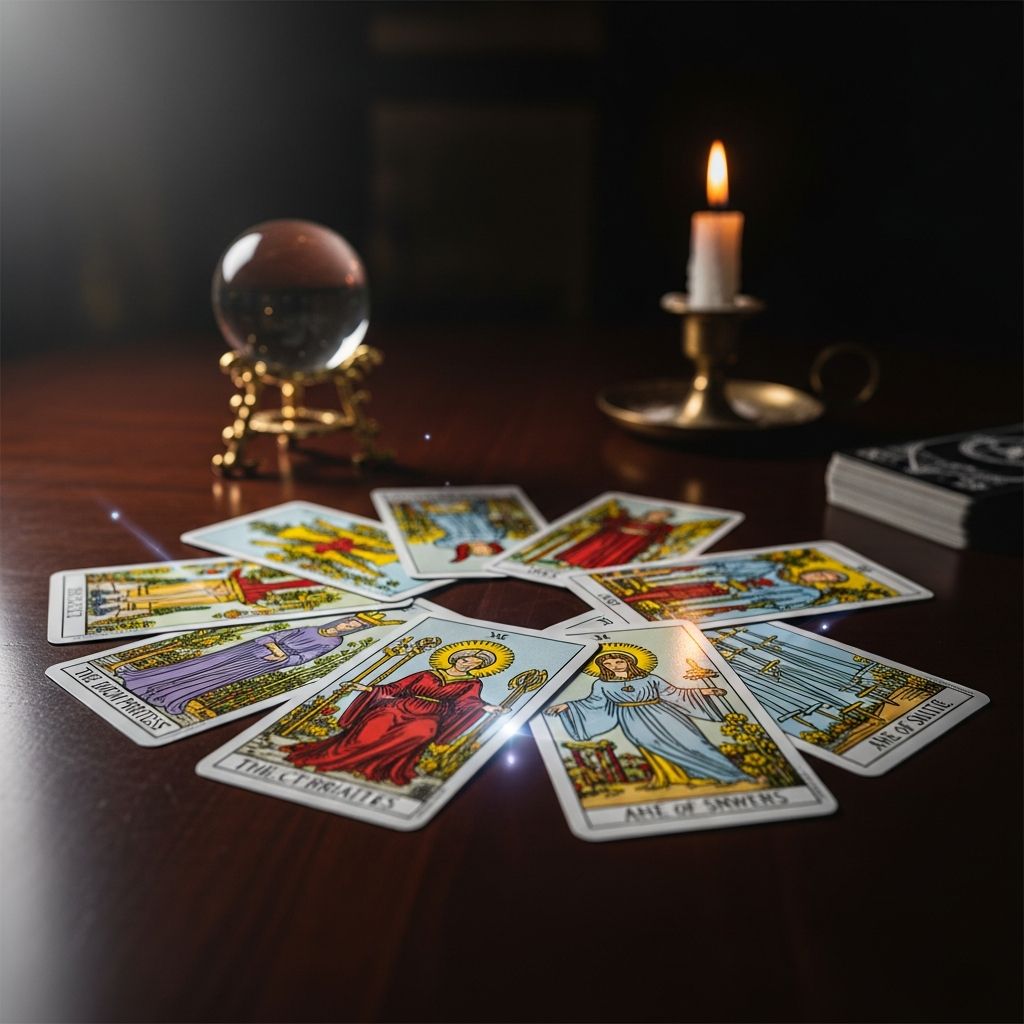
When seeking guidance from tarot, many people find themselves drawn to straightforward questions that demand clear responses. Rather than engaging in lengthy, open-ended readings, some individuals prefer tarot practices that deliver specific, actionable insights. This approach to card reading has developed into a specialized field with distinct methodologies, varied interpretations, and practical applications that help querents navigate important life decisions.
Understanding Direct Question Tarot Practices
The foundation of seeking clear answers through tarot rests on understanding what types of questions work best with this approach. Direct questioning in tarot readings typically falls into three primary categories that shape how readers structure their spreads and interpret the cards drawn.
The first category encompasses inquiries about potential future occurrences. These questions focus on whether specific events will manifest, such as “Will I receive a job offer?” or “Will this relationship progress?” These event-based questions require readers to assess the likelihood and energetic momentum surrounding a particular outcome.
The second category addresses relational dynamics and emotional connections. Questions like “Does this person care about me?” or “Are we compatible?” require readers to interpret cards through the lens of interpersonal energy and emotional resonance. These inquiries often need more nuance than a simple affirmation or denial.
The third category involves decision-making and personal action. Questions phrased as “Should I pursue this opportunity?” or “Is this the right choice?” demand that readers identify whether the querent’s desired action aligns with their circumstances, values, and potential outcomes.
Card Associations and Their Meanings
One practical approach to obtaining clear answers involves assigning interpretative values to different cards within the deck. This systematic method creates a framework where each card carries inherent directional energy.
Within the minor arcana, suit associations carry significant weight. Cards from the suit of Cups and Wands traditionally lean toward affirmative responses, representing emotional fulfillment, creative momentum, and positive flow. Conversely, Swords and Pentacles often reflect hesitation or negative indicators, representing mental complications or material obstacles.
Numerical values also matter within this interpretative structure. Within the Sword suit, cards like the 3, 5, 7, 8, 9, and 10 typically indicate resistance or unfavorable conditions. However, the Ace, 4, and 6 of Swords suggest more supportive energy. This pattern varies across suits but provides readers with a consistent reference framework.
The major arcana presents a unique consideration. Certain cards like The High Priestess, The Hierophant, The Chariot, The Wheel of Fortune, Justice, The Hanged Man, and Judgment often function as neither clearly affirmative nor negative. Instead, these cards suggest conditional answers, indicating that circumstances require additional consideration or that timing plays a crucial role.
Establishing a Clear Interpretative Foundation
Before conducting a reading focused on obtaining direct answers, readers benefit from establishing their personal interpretative guidelines. This foundation determines how individual cards will be read within the context of the question posed. Different readers may assign different values to the same card, and this variation reflects the intuitive nature of tarot practice.
A common framework involves categorizing cards into three groups:
- Affirmative cards: Those carrying positive momentum, growth potential, and supportive energy
- Negative cards: Those indicating obstacles, resistance, completion of something, or recommended caution
- Neutral or conditional cards: Those suggesting ambiguity, timing considerations, or the need for additional work or reflection
The actual determination of which cards fall into each category depends on the reader’s training, intuitive development, and experience with the deck.
Multi-Card Spread Techniques
While single-card draws offer simplicity, multi-card spreads provide richer context and more reliable guidance. Several established spread configurations have proven effective for seeking direct answers while maintaining interpretative depth.
The Contextual Factors Spread
This approach addresses the reality that most situations contain both supporting and opposing elements. Rather than forcing a binary answer, readers draw cards representing factors that support a positive outcome and factors that oppose it.
The spread typically uses three cards minimum: one representing what supports the desired outcome, one representing what opposes it, and often a third card offering guidance or clarification. This structure acknowledges that few life situations are completely black or white, and understanding the landscape surrounding a question often proves more valuable than a simple affirmative or negative response.
Readers can expand this spread by adding additional supporting or opposing factor cards, creating a more comprehensive picture of the situation’s complexity.
The Holistic Perspective Spread
When addressing “Should I?” questions specifically, some readers employ a three-card spread examining different dimensions of the querent’s being. This approach recognizes that decision-making involves intellectual, physical, and spiritual components.
The first card reveals what the mind knows or thinks about the situation. The second card addresses what the body wants or needs. The third card uncovers what the spirit or deeper self desires. Together, these three cards help querents understand whether their rational thinking, physical instincts, and spiritual alignment all point in the same direction or whether internal conflict exists.
This method proves particularly helpful when a querent feels torn between competing desires or when external expectations conflict with internal truth.
The Progressive Path Spread
For questions centered on achieving specific goals, this three-card spread maps the journey from present circumstances toward the desired outcome.
The first card represents the current situation or the querent’s starting point. The second card or series of cards reveal the steps or actions necessary to move toward the goal. The third card shows the likely outcome if these steps are taken.
This spread can be expanded by adding multiple cards in the middle position, creating a more detailed roadmap. Some readers use this expansion to identify potential obstacles that might arise during the journey and how to navigate them.
The Ace-Based Counting Method
An alternative approach focuses on the frequency and type of aces appearing within shuffled piles. This method removes much of the interpretative variable by relying on a numerical system.
To use this technique, a shuffled deck is divided into four equal piles. Working through each pile from top to bottom, the reader flips cards one at a time until either an ace is revealed or thirteen cards have been turned over. This process repeats for all four piles.
The final count of aces determines the answer:
- Four aces: Definitely affirmative
- Three aces: Probably affirmative
- Two aces: Uncertain or conditional
- One ace: Probably negative
- Zero aces: Definitely negative
The cards revealed while searching for aces offer additional context. Suit associations matter: the Ace of Swords reflects mental clarity, the Ace of Cups represents emotional support, the Ace of Wands indicates creative drive or passion, and the Ace of Pentacles suggests material or practical stability. Missing aces paired with specific major arcana cards can reveal what’s blocking the desired outcome.
The Three-Pile Ace Methodology
Another classical technique uses three piles instead of four, drawing from historical tarot interpretations. After shuffling while holding the question in mind, the deck is worked through one card at a time until either an ace appears or thirteen cards have been drawn.
This process creates three distinct piles. If only one ace appears in the entire spread, that single upright ace indicates a positive answer while a reversed ace suggests a negative one. When two aces appear, the leftmost ace reveals the ultimate outcome while the rightmost reveals the immediate situation.
Three aces appearing throughout the spread indicates a clear affirmative response, though reversed aces within this grouping suggest that delays or obstacles may complicate the positive outcome.
Orientation-Based Interpretation
Some readers incorporate card orientation into their direct-answer methodology. In this approach, the direction a card falls during the shuffle carries significance for interpretation.
Upright cards traditionally lean toward affirmative energy and positive indicators, while reversed cards suggest caution, resistance, or negative indicators. However, this framework works best when combined with deeper card meaning interpretation, as the card’s message often provides more nuance than orientation alone.
Practical Application and Real-World Examples
Consider a querent asking about career advancement with a potential company. Using the contextual factors approach, a reader might draw the 3 of Wands as a supporting factor. This card suggests that the company truly does offer expansion opportunities and authentic growth potential for the querent’s career trajectory. The 8 of Cups might appear as an opposing factor, indicating that although the position seems attractive, greater opportunities exist elsewhere that would better serve the querent’s long-term aspirations.
This reading doesn’t provide a simple yes or no but instead offers the wisdom that the querent should look beyond the immediate opportunity, as their ideal path lies in a different direction.
When using the ace-counting method, a querent might receive two aces: the Ace of Swords and the Ace of Cups. This hard-maybe answer reveals that the querent possesses the mental clarity and thorough planning necessary for success, along with strong emotional support from people around them. However, missing aces in Pentacles and Wands might indicate that financial resources are unstable or that some passion is missing. Pairing these observations with major arcana cards like Temperance and The Devil could suggest internal conflict between desire and discipline, revealing a potential path forward through inner work.
Beyond Simple Binary Answers
The most sophisticated approach to direct-answer tarot reading recognizes that life situations rarely reduce to simple yes or no responses. Even when a querent seeks a straightforward answer, the cards often provide something far more valuable: context that empowers decision-making.
A no answer frequently contains redirection, suggesting that effort might be better invested elsewhere or that the querent needs to address certain internal patterns before proceeding. A yes answer sometimes comes with conditions, indicating that success requires specific actions or timing considerations.
Some readers use a three-card format specifically designed to address this complexity: one card for “if yes,” another for “if no,” and a third offering broader guidance regardless of which direction the reading suggests. This approach acknowledges that querents benefit most when they understand not just what might happen, but why, and what their role in manifesting or preventing that outcome might be.
Developing Personal Practice
Creating a consistent direct-answer tarot practice involves experimenting with different spreads and methodologies until finding approaches that resonate with both the reader’s intuition and their querents’ needs. Some readers prefer the mathematical simplicity of ace-counting, while others feel more connected to multi-card spreads that allow for richer interpretation.
Regardless of chosen method, maintaining a reading journal helps readers track accuracy, identify patterns in their interpretations, and refine their personal framework over time. This documentation reveals which spreads consistently provide reliable guidance and helps readers recognize their biases or assumptions that might color interpretation.
Frequently Asked Questions
Can tarot truly provide clear yes or no answers?
Tarot functions best when understood as a tool for reflection and gaining perspective rather than as an oracle delivering predetermined facts. The cards can suggest energetic direction, identify relevant factors, and illuminate options, but they work in collaboration with the querent’s intuition and decision-making capacity.
What if cards suggest an unclear answer?
Ambiguous cards or spreads often carry the most important message: the situation requires more thought, timing isn’t right, or additional factors need consideration. Sometimes the most valuable answer tarot provides is “not yet” or “look deeper.”
Should reversed cards always mean no?
Reversed cards carry nuance. They might indicate delays, internal obstacles, blocked energy, or the need for a different approach rather than a simple negative. Their meaning depends on context and the specific card involved.
How often should someone seek direct-answer readings?
Frequent readings on the same question can create dependency rather than empowerment. Most experienced readers recommend waiting at least several weeks before seeking clarification on a previously answered question, allowing time for circumstances to develop and the querent’s own clarity to deepen.
References
- How to Answer Yes / No Questions with Tarot – Labyrinthos Academy — Labyrinthos. https://labyrinthos.co/blogs/learn-tarot-with-labyrinthos-academy/how-to-answer-yes-no-questions-with-tarot-4-yes-or-no-tarot-spreads
- Yes or No Tarot Spread Using the Children of Litha Tarot Deck — Xia Hunt. https://www.xiahunt.com/blogs/news/tarot-yes-or-no-spread-using-the-children-of-litha-tarot-deck
- Tarot Spreads for a Yes/No Answer — The Spells8 Forum. https://forum.spells8.com/t/tarot-spreads-for-a-yes-no-answer/61563
- How to Read for Yes/No Answers in Tarot — Creative Soul Tarot. https://www.creativesoultarot.com/post/how-to-read-for-yes-no-answers-in-tarot
- Answering Yes or No Questions with Tarot — Tarot Parlor. https://www.tarotparlor.com/blog/answering-yes-or-no-questions-with-tarot
- Yes/No Readings – Quick Guide — The Tarot Forums. https://forum.thetarot.guru/t/yes-no-readings-quick-guide/456
Similar Articles








Read full bio of Sneha Tete