Rune Stone Meanings: 24 Elder Futhark Symbols Explained
Unlock the ancient wisdom of Norse runes: their history, symbolism, and modern divination power in one comprehensive guide.
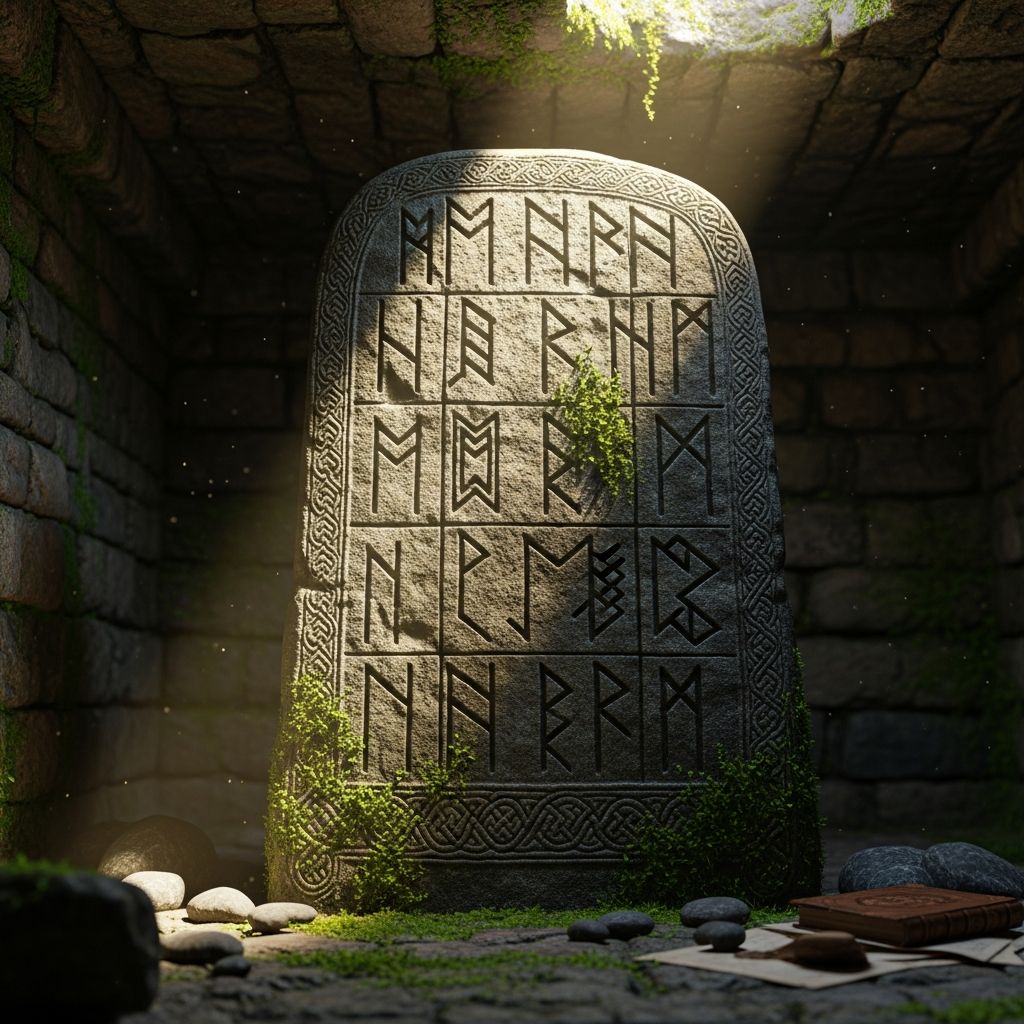
Rune stones represent one of the most enigmatic and powerful systems of ancient symbolism from Norse and Germanic traditions. Carved into stones or wood, these angular symbols served multiple purposes: writing, commemoration, and divination. Originating around the 1st to 2nd century CE, runes evolved through distinct alphabets like the Elder Futhark and Younger Futhark, each carrying layered meanings tied to mythology, nature, and human experience. Today, they continue to inspire spiritual practitioners worldwide.
The Ancient Roots of Runes
The story of runes begins in the shadowy intersection of Germanic tribes and Mediterranean influences. Scholars trace their development to the 1st century CE, with the earliest unambiguous inscriptions appearing around 160 CE on artifacts like the Vimose comb in Denmark and the Øvre Stabu spearhead in Norway. The recent discovery of the Svingerud Stone, dated between 1-250 CE via radiocarbon analysis, stands as the oldest known rune stone, unearthed in a Norwegian grave field by the Museum of Cultural History at the University of Oslo. This find challenges previous timelines, suggesting runes emerged even earlier, possibly inspired by Old Italic alphabets encountered through trade or warfare.
Runes were not mere letters; they embodied sacred power. Germanic peoples viewed them as gifts from Odin, the Allfather, who hung from Yggdrasil for nine days to gain their knowledge. Early inscriptions on weapons, jewelry, and brooches from southern Scandinavia reveal a script adapted for carving on hard surfaces, featuring straight lines suited to stone and metal. By the Roman Iron Age (up to 550 CE), only about 30 such stones existed in Norway, but the Svingerud example, with its fragmented Proto-Norse text, hints at experimental writing practices.
Evolution of Runic Alphabets
Runes progressed through several futharks—named for the first six symbols: F, U, Þ, A, R, K. The Elder Futhark, emerging around the 2nd century CE, comprised 24 characters used by Germanic tribes across Northern Europe. This system captured the sounds and concepts of Proto-Norse, with each rune holding phonetic, ideographic, and divinatory significance.
Around the 8th century, linguistic shifts led to the Younger Futhark, a streamlined 16-rune alphabet dominant during the Viking Age (793-1066 CE). This reduction reflected phonetic changes, making it more efficient for Old Norse but challenging for modern readers due to ambiguous sounds. The full Elder Futhark sequence first appears carved on the Kylver Stone from Gotland, Sweden, circa 400 CE. Viking-era stones, peaking between 950-1100 CE, number over 6,000 in Scandinavia, mostly in Sweden, often painted red for visibility and erected as memorials.
| Alphabet | Era | Number of Runes | Key Features |
|---|---|---|---|
| Elder Futhark | 2nd-8th century CE | 24 | Versatile for Proto-Norse; mythological ties |
| Younger Futhark | 8th-12th century CE | 16 | Simplified for Old Norse; Viking memorials |
| Anglo-Saxon Futhorc | 5th-11th century CE | 28-33 | Expanded for English dialects |
Decoding the Elder Futhark: Core Symbolism
The Elder Futhark divides into three aettir (families of eight runes), each governed by a deity: Freyr (fertility), Heimdall (guardian), and Tyr (warrior). Below, we explore their upright and reversed (merkstave) meanings, drawn from historical inscriptions and traditional interpretations.
First Aett: Freyr’s Domain
- Fehu (ᚠ): Cattle, wealth, mobile possessions. Upright: Prosperity, success through effort. Reversed: Loss, greed blocking flow.
- Uruz (ᚢ): Aurochs, primal strength. Upright: Vitality, health. Reversed: Weakness, illness.
- Thurisaz (ᚦ): Thorn, giant. Upright: Protection, directed force. Reversed: Conflict, danger.
- Ansuz (ᚨ): Odin, divine inspiration. Upright: Communication, wisdom. Reversed: Misunderstanding, manipulation.
- Raido (ᚱ): Wagon, journey. Upright: Travel, rhythm. Reversed: Stagnation, disruption.
- Kenaz (ᚲ): Torch, knowledge. Upright: Creativity, enlightenment. Reversed: Ignorance, destruction.
- Gebo (ᚷ): Gift, partnership. Upright: Balance, exchange. No reverse (balanced energy).
- Wunjo (ᚹ): Joy, harmony. Upright: Happiness, success. Reversed: Sorrow, isolation.
Second Aett: Heimdall’s Watch
- Hagalaz (ᚺ): Hail, disruption. Upright: Radical change, crisis. No reverse (natural force).
- Nauthiz (ᚾ): Need, constraint. Upright: Endurance, necessity. Reversed: Resistance, poverty.
- Isa (ᛁ): Ice, stillness. Upright: Pause, introspection. No reverse (static).
- Jera (ᛃ): Year, harvest. Upright: Cycles, reward. No reverse (long-term).
- Eihwaz (ᛇ): Yew tree, reliability. Upright: Endurance, death/rebirth. Reversed: Confusion, vulnerability.
- Perthro (ᛈ): Lot cup, mystery. Upright: Fate, gambling. Reversed: Stagnation, hidden enemies.
- Algiz (ᛉ): Elk, protection. Upright: Shield, sanctuary. Reversed: Exposure, warning.
- Sowilo (ᛊ): Sun, victory. Upright: Guidance, wholeness. No reverse (pure positive).
Third Aett: Tyr’s Valor
- Tiwaz (ᛏ): Tyr, justice. Upright: Honor, leadership. Reversed: Imbalance, dishonor.
- Berkano (ᛒ): Birch, growth. Upright: Fertility, nurturing. Reversed: Loss, sterility.
- Ehwaz (ᛖ): Horse, loyalty. Upright: Partnership, progress. Reversed: Disharmony, retreat.
- Mannaz (ᛗ): Humanity, self. Upright: Community, intelligence. Reversed: Alienation, manipulation.
- Laguz (ᛚ): Water, intuition. Upright: Flow, emotion. Reversed: Fear, blockage.
- Ingwaz (ᛜ): Ing, fertility. Upright: Potential, gestation. No reverse (internal).
- Dagaz (ᛞ): Day, breakthrough. Upright: Clarity, transformation. No reverse (paradoxical).
- Othala (ᛟ): Ancestral property. Upright: Heritage, home. Reversed: Alienation, prejudice.
These meanings blend phonetic roles with esoteric layers, as seen in Viking stones commemorating voyages or conversions to Christianity.
Rune Stones in Viking Society
During the Viking Age, rune stones became monumental testaments. Over 3,000 survive in Sweden alone, raised from the 4th century in Norway/Sweden, peaking 950-1100 CE. Typically granite, 6-10 feet tall, they memorialized the dead, boasted achievements, or marked property. The Jelling Stones in Denmark, erected by Harald Bluetooth around 970 CE, proclaim his parents’ honors and his Christian unification of Denmark.
Functions included:
- Memorials with family ties and prayers.
- Self-promotion of travels or raids.
- Religious statements, blending pagan runes with Christian crosses.
Painted and visible, they proved Viking literacy.
Modern Divination with Runes
Today, rune casting revives Elder Futhark for guidance. Cast 3-5 stones or draw from a pouch, interpreting spreads like past-present-future. Bindrunes combine symbols for talismans; galdr uses rune sounds in chants. Unlike tarot, runes emphasize personal responsibility and Norse fatalism.
Sample Reading: For career query—Fehu upright (new wealth), crossed by Thurisaz reversed (overcome obstacles), resolved by Jera (patient reward).
Practical Tips for Beginners
- Acquire a set: Wood, stone, or crystal replicas.
- Consecrate: Cleanse with smoke, charge under moonlight.
- Journal interpretations to track patterns.
- Study mythology: Link runes to Eddas for depth.
Frequently Asked Questions
What is the oldest rune stone?
The Svingerud Stone from Norway, dated 1-250 CE, holds that title.
Can runes predict the future?
Runes offer insights into energies and choices, not fixed predictions.
How do I learn rune meanings?
Start with Elder Futhark charts, meditate on each symbol daily.
Are rune stones only for pagans?
No, used across spiritual paths for reflection and intuition.
What’s the difference between Elder and Younger Futhark?
Elder has 24 runes for broader sounds; Younger 16 for Viking Norse.
References
- History and significance of the rune stones — Battle-Merchant. N/A. https://www.battlemerchant.com/en/blog/history-and-significance-of-the-rune-stones
- Found the world’s oldest rune stone — Museum of Cultural History, University of Oslo. 2021. https://www.khm.uio.no/english/news/found-the-world-s-oldest-rune-stone.html
- The Oldest Runestone Conveys Norse Language Before the Viking Age — Discover Magazine. N/A. https://www.discovermagazine.com/the-oldest-runestone-conveys-norse-language-before-the-viking-age-47061
- Rune Stones — Milwaukee Public Museum. N/A. https://www.mpm.edu/index.php/research-collections/anthropology/online-collections-research/scandinavian-archaeology/rune-stones
- The Origins of the Runes — Norse Mythology for Smart People. N/A. https://norse-mythology.org/runes/the-origins-of-the-runes/
Similar Articles



Read full bio of medha deb