Playing Card Divination: A Practical Guide To Reading Cards
Discover how standard playing cards became powerful instruments for spiritual guidance and fortune-telling practices.
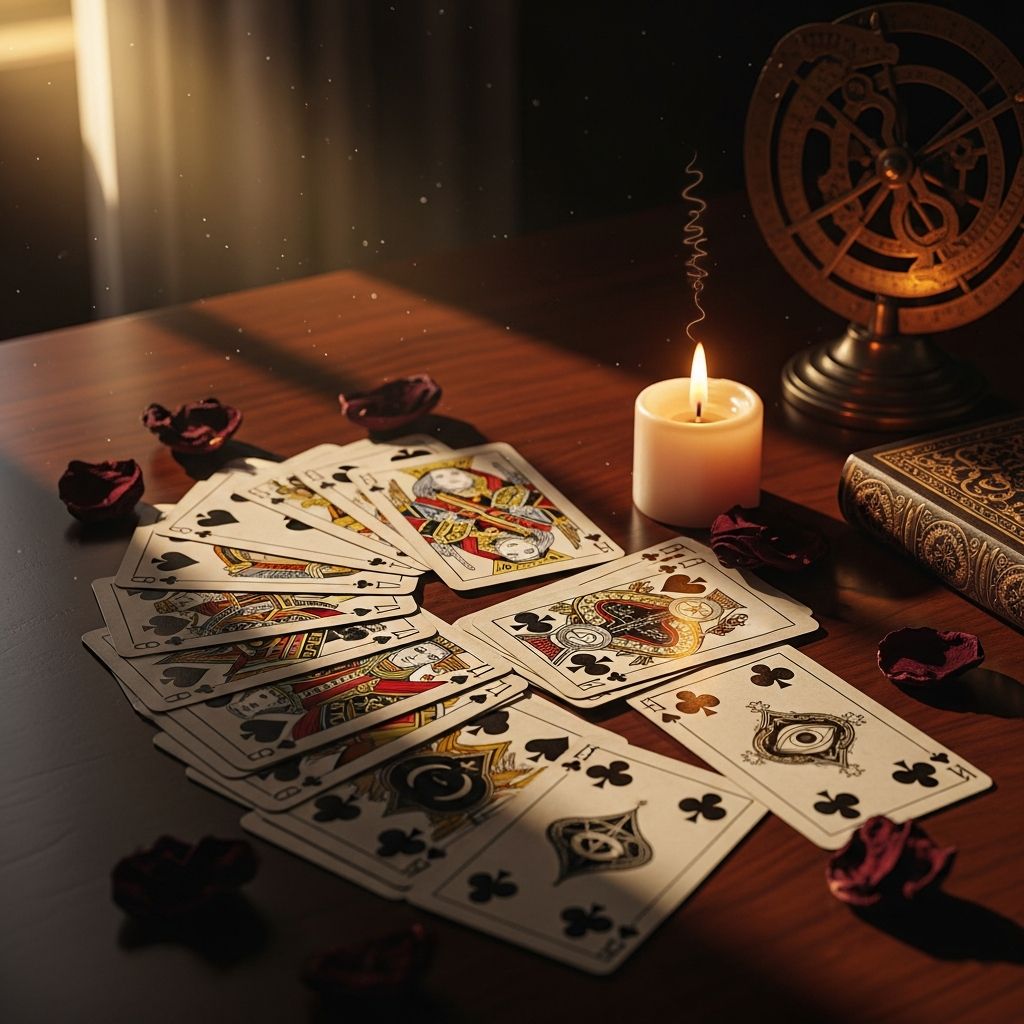
For centuries, playing cards have entertained people around the world through countless games and pastimes. Yet beneath their recreational surface lies a deeper potential that many practitioners recognize as a gateway to insight and spiritual understanding. While tarot decks have gained prominence in modern divination culture, the humble playing card—the same deck used for poker, bridge, or solitaire—holds equally powerful divination capabilities. This transformation from entertainment to spiritual tool represents a fascinating intersection of history, symbolism, and human curiosity about the unseen forces that shape our lives.
The Historical Journey: From Entertainment to Divination
The earliest tarot cards emerged in Renaissance Italy during the 1440s and 1450s, initially designed purely as gaming cards rather than mystical instruments. The first documented tarot decks were recorded between 1440 and 1450 in Milan, Ferrara, Florence and Bologna, when additional trump cards with allegorical illustrations were added to the common four-suit pack. These decks featured the Italian suit system of cups, swords, batons, and coins—a structure that remains foundational to card-based games and divination systems today.
The critical turning point in card history occurred much later than most people assume. Scholarly research has demonstrated that tarot cards were invented in northern Italy in the mid-15th century and confirmed that there is no historical evidence of any significant use of tarot cards for divination until the late 18th century. This gap of roughly three centuries reveals an important truth: divination through cards is a relatively modern spiritual practice, despite its aura of ancient wisdom.
The popularization of card divination coincided with the rise of occult movements in Europe during the Enlightenment. The use of Tarot cards for divinatory purposes really took off only after Antoine Court de Gébelin (1725-1784) makes a claim for the Egyptian origins of Tarot. This attribution—though historically unfounded—lent mystique and perceived authority to the practice. Subsequent occultists, including the infamous Aleister Crowley, further developed elaborate symbolic systems around these cards, weaving them into broader esoteric frameworks that continue to influence modern practice.
Standard Playing Cards vs. Specialized Tarot Decks
A common misconception holds that divination requires expensive, ornate tarot decks purchased from specialty shops. In reality, standard playing cards offer distinct advantages for divination work:
- Accessibility: Nearly everyone has a playing card deck available, making divination practice immediately possible without special purchases
- Simplicity: The 52-card structure (excluding jokers) is straightforward to memorize and interpret, unlike tarot’s 78-card complexity
- Universal symbolism: Playing card suits carry centuries of established meaning that transcends cultural boundaries
- Psychological clarity: The reduced deck size forces practitioners to develop deeper interpretive skills rather than relying on complex card meanings
- Practical flexibility: Playing cards can be easily carried, used anywhere, and integrated into daily divination practice without drawing excessive attention
The historical record shows that some older patterns, such as the Tarot de Marseille and the Swiss 1JJ Tarot, originally intended for playing card games, are also used for cartomancy. This historical overlap demonstrates that the distinction between game cards and divination cards remains largely artificial—the cards themselves are neutral tools whose meaning emerges through the practitioner’s intention and interpretation.
Understanding the Suit System and Symbolic Structure
Playing cards organize their 52 cards into four suits, each carrying distinct symbolic associations that have evolved through centuries of use. Understanding these symbols forms the foundation of effective card divination:
| Suit | Traditional Association | Divination Meaning | Elemental Connection |
|---|---|---|---|
| Hearts | Cups/Chalices | Emotions, relationships, creativity, and matters of the heart | Water |
| Diamonds | Coins/Pentacles | Material wealth, resources, career, and practical matters | Earth |
| Clubs | Batons/Wands | Energy, passion, growth, and spiritual development | Fire |
| Spades | Swords | Challenges, clarity, communication, and intellectual pursuits | Air |
An early pattern of playing cards used the suits of batons or clubs, coins, swords, and cups. These suits are still used in traditional Italian, Spanish and Portuguese playing card decks, and are also used in modern (occult) tarot divination cards that first appeared in the late 18th century. This continuity of symbolism across centuries provides a rich archetypal foundation for interpretation.
Within each suit, the numbered cards (2-10) carry meanings based on their numerical value, while the face cards—jack, queen, king, and occasionally ace—represent more complex archetypal energies. The ace typically signifies new beginnings or pure potential, while the court cards embody different personality types or life roles that shift based on surrounding cards and the specific question posed.
Basic Divination Methods Using Standard Playing Cards
Several accessible approaches allow practitioners to begin working with playing cards immediately:
The Three-Card Spread
This foundational technique provides quick insight into past influences, present circumstances, and future outcomes. After focusing on a question while shuffling, draw three cards and interpret them in sequence. The simplicity of this spread makes it ideal for daily practice and developing interpretive intuition.
The Daily Card Draw
Drawing a single card each morning and reflecting on its meaning throughout the day cultivates consistent practice and deepens familiarity with each card’s symbolic dimensions. This method proves particularly valuable for recognizing patterns and subtle meanings that emerge through repetition.
The Suit-Based Reading
Separating the deck by suit and drawing one card from each creates a comprehensive four-dimensional perspective on any situation, addressing emotional, material, energetic, and intellectual aspects simultaneously.
The Numerical Spread
Laying out cards in patterns corresponding to numerologically significant numbers—seven, nine, thirteen—creates frameworks for exploring complex questions through layered interpretation.
Interpreting Court Cards and Face Values
The face cards deserve special attention as they carry archetypal significance beyond their numerical position:
- Jacks represent younger energy, communication, and active exploration; they embody the qualities of messengers and seekers
- Queens embody receptive, nurturing energy associated with intuition, creativity, and the inner chamber of consciousness
- Kings signify authority, mastery, and established power; they represent the mature, confident expression of each suit’s qualities
- Aces function as powerful new beginnings and pure potential, carrying the concentrated essence of their respective suit
Number cards carry meanings rooted in both numerological principles and their position within the sequence from 1 to 10. The number 2 suggests duality and choice, 3 indicates creativity and expression, while 10 represents completion and cycles beginning anew. These associations remain consistent regardless of suit, though the specific life area changes based on which suit appears.
Developing Personal Meanings and Intuitive Connection
While established meanings provide a foundation, the most powerful divination work emerges when practitioners develop personal relationships with each card. Creating a divination journal where you record impressions, patterns, and unexpected insights builds a personalized system that resonates with your unique intuitive voice.
Many experienced readers discover that certain cards consistently appear during specific life circumstances, creating personal correspondences that supersede traditional meanings. A particular ace might signal creative opportunities in your experience, or a specific face card might consistently appear when relationship matters require attention. Honoring these personal patterns strengthens the divination process and deepens trust in your interpretive abilities.
Meditation with individual cards accelerates the development of intuitive connection. Selecting a single card and spending 10-15 minutes contemplating its imagery, colors, and symbolic associations activates deeper cognitive patterns and strengthens the subconscious links between card and meaning.
Common Questions About Playing Card Divination
Can regular playing cards work as effectively as tarot decks?
Yes. The simplicity of the 52-card structure often proves superior to tarot’s complexity for developing interpretive skills. Many experienced practitioners prefer working with standard decks precisely because their reduced vocabulary encourages deeper engagement with each card’s meaning.
Do I need to cleanse or consecrate my cards?
While many practitioners enjoy rituals involving moonlight exposure, saltwater, or incense, such practices remain optional. The most important factor is your intention and focused attention. Some readers successfully work with cards that have never been formally cleansed, while others maintain rigorous ritual practices. Choose approaches that align with your personal beliefs and spiritual framework.
How do reversed cards affect interpretation?
Some practitioners use reversed cards (drawn upside-down) to indicate blocked energy, contrary meanings, or internal reflection rather than external manifestation. Others read only upright cards, believing that all meanings exist on a spectrum within each card rather than as binary opposites. Both approaches prove valid; choose the system that resonates with your interpretive style.
What role does intuition play versus memorized meanings?
Balance both elements. Memorized meanings provide structure and prevent arbitrary interpretation, while intuition allows the cards to speak to your specific situation in unexpected ways. The most accurate readings typically emerge when solid knowledge provides a foundation upon which intuitive insights can build.
Ethical Considerations in Card Reading
As playing card divination gains recognition, practitioners should maintain ethical standards that respect both the tool and the person seeking guidance. Never guarantee that cards can predict the future with certainty, as this misrepresents their actual function—they reveal patterns, potentials, and perspectives rather than fixed destinies. Present readings as tools for reflection and insight rather than absolute truth.
Respecting client confidentiality, avoiding readings when emotionally compromised, and declining to make critical life decisions solely based on card readings all contribute to responsible practice. The cards work most effectively when they support rather than replace human judgment, intuition, and agency.
Conclusion: The Enduring Power of Cards
The journey from Renaissance gaming cards to modern divination tools reflects humanity’s persistent desire to understand patterns beneath surface reality. Playing cards, stripped of the mystique and expense surrounding specialty decks, offer direct access to this ancient practice. Their very ordinariness becomes their greatest strength—a familiar object transformed through intention and attention into a gateway for insight, reflection, and deeper self-understanding. Whether approached as spiritual practice, psychological tool, or creative exercise, playing card divination continues the centuries-old tradition of finding meaning in chance and pattern, offering anyone willing to look beneath the surface an unexpected window into their own wisdom.
References
- Tarot — Wikipedia. Accessed 2026-03-22. https://en.wikipedia.org/wiki/Tarot
- The Fascinating History of Tarot Card Decks: From the Renaissance to the Modern Day — Open Culture. 2025-11. https://www.openculture.com/2025/11/the-fascinating-history-of-tarot-card-decks-from-the-renaissance-to-the-modern-day.html
- A Brief History of Cartomancy — French Playing Cards (MIT). Accessed 2026-03-22. https://frenchplayingcards.mit.edu/tarot/tarot-history
- Before Fortune-Telling: The History and Structure of Tarot Cards — The Metropolitan Museum of Art. Accessed 2026-03-22. https://www.metmuseum.org/perspectives/tarot-2
- From Playing Cards to Divination — The Strong National Museum of Play. Accessed 2026-03-22. https://www.museumofplay.org/blog/from-playing-cards-to-divination/
Similar Articles







Read full bio of medha deb