The Devil Card: Meaning, Shadow Work, And Liberation
Understand the Devil tarot card's deeper symbolism and what it reveals about your inner world.
The Devil card occupies a unique and often misunderstood position within tarot’s major arcana. While many people recoil from its imagery and associations, this card carries profound messages about personal empowerment, self-awareness, and the human condition. Rather than representing pure evil, the Devil card functions as a mirror reflecting the self-imposed limitations, hidden desires, and internal conflicts that shape our lives. Understanding its nuanced meaning reveals how this seemingly ominous card actually invites transformation and liberation.
Visual Representation and Symbolic Elements
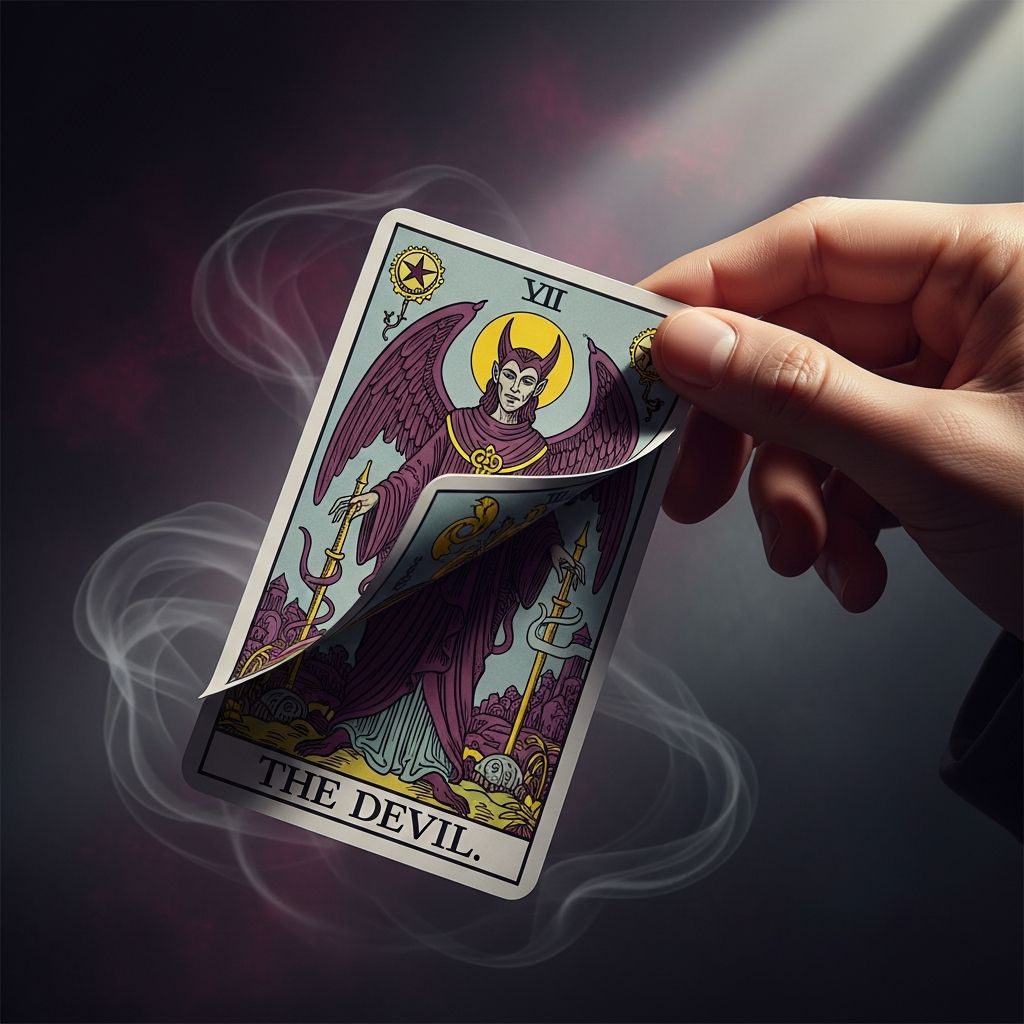
The Devil card presents a compelling visual narrative through its detailed imagery. The figure typically appears in a satyr-like form, combining human and animal characteristics to represent the union of our higher consciousness and base instincts. This hybrid nature symbolizes the duality within all of us—the constant tension between our spiritual aspirations and our earthbound desires.
Central to the card’s composition are two chained figures standing before the Devil. These individuals bear a striking resemblance to the lovers depicted in the Lovers card, yet they appear corrupted, wearing horns and tails as markers of their spiritual descent. The loose chains binding them carry particular significance, as they symbolize that captivity exists only when we accept it. The figures could release themselves at any moment, highlighting a crucial truth: our bondage is often self-imposed rather than externally mandated.
Additional symbolic elements enrich the card’s meaning:
- The inverted pentagram on the Devil’s forehead represents the inversion of spiritual values and the domination of material concerns over divine wisdom
- Bat wings suggest darkness, fear, and the hidden aspects of ourselves we refuse to acknowledge
- The pedestal upon which the Devil stands indicates his perceived power and authority over those who believe in his dominion
- Horns appearing on the chained figures symbolize their enslavement to animalistic impulses and base desires
- Accessories adorning the figures—such as flames or grapes—represent specific attachments: the pursuit of power, pleasure, or material abundance at the expense of spiritual growth
The Shadow Self and Inner Sabotage
At its core, the Devil card represents what Jungian psychology calls the shadow self—those aspects of our personality and desires that we deny, repress, or refuse to acknowledge. This internal saboteur operates through an insidious whisper that convinces us we are unworthy of success, incapable of change, and permanently confined by our circumstances.
This voice often emerges precisely when we stand on the precipice of significant breakthrough or transformation. Just as we prepare to transcend our limitations, the Devil speaks through self-doubt, fear, and fatalism. The card teaches that recognizing this voice as the “Prince of Lies” becomes essential to spiritual advancement. The greatest deception the Devil perpetrates is convincing us of his superiority and our helplessness.
The shadow manifests through multiple channels:
- Fear-based thinking that prevents us from taking necessary risks
- Excessive attachment to material possessions or status symbols
- Addiction patterns—whether to substances, behaviors, or relationships
- Unresolved jealousy, anger, and resentment toward others
- Unforgiveness of ourselves and those who have hurt us
- Prioritization of comfort and survival over growth and purpose
Astrological Associations and Planetary Influence
The Devil card maintains strong connections to astrological symbolism, particularly through its association with Capricorn and the planet Saturn. These connections provide additional layers of interpretation and understanding.
Capricorn, the zodiac sign linked to this card, represents the darkest time of the year when the sun reaches its lowest point before rebirth at the Winter Solstice. This astronomical reality mirrors the card’s invitation to descend into our darkest places in order to facilitate resurrection and renewal. The goat symbolism inherent in Capricorn connects to the Devil’s satyr imagery, creating a coherent astrological narrative.
Saturn, the ruling planet of Capricorn, brings its own profound symbolism:
- Saturn represents limitations, boundaries, and the constraints we encounter in life
- Its rings symbolize the boundaries that structure human experience and restrict unlimited freedom
- Saturn rules the process of self-improvement through time and persistent effort
- The planet emphasizes discipline, accountability, and the consequences of our choices
- Saturn’s influence calls us to confront reality honestly, stripping away illusions and wishful thinking
Some tarot traditions also attribute Mars to the Devil card, emphasizing the raw creative energy, struggle, and passion necessary for transformation. This additional planetary association reinforces the card’s connection to primal forces and the intense energy required to break free from self-imposed bondage.
Interpreting the Devil in Different Life Areas
Romantic Relationships and Attraction
When the Devil appears in matters of the heart, it often signals complex emotional dynamics characterized by intensity and obsession. This person or relationship may feel captivating yet tumultuous, drawing you in with magnetic energy while simultaneously creating a sense of entrapment.
For those currently single, the Devil warns against repeating destructive relationship patterns from the past. It suggests becoming aware of your vulnerabilities and the manipulative tactics to which you might be susceptible. The card emphasizes understanding your triggers and recognizing the deceptions that commonly ensnare you in unhealthy romantic cycles.
The Devil in relationships invites honest examination of whether you are experiencing genuine connection or merely enacting familiar dysfunction. It encourages breaking free from the gravitational pull of past patterns and making conscious choices aligned with your authentic needs.
Personal and Spiritual Development
In readings focused on personal growth, the Devil card represents the crucial moment of choosing between remaining imprisoned by limiting beliefs or claiming your freedom through honest self-examination. This card does not suggest that change is impossible; rather, it emphasizes that change requires confronting the uncomfortable truths about ourselves and our circumstances.
The card’s appearance in development readings signals that growth depends on your willingness to acknowledge your shadow aspects without judgment or rationalization. Only by facing these internal obstacles directly can you transcend them and evolve into a more authentic version of yourself.
Professional and Financial Matters
When appearing in career or financial contexts, the Devil may indicate becoming overly attached to material success, status symbols, or external validation. It warns against sacrificing integrity, relationships, or wellbeing in pursuit of professional advancement or financial gain.
The card may also signal addiction to work itself—using professional pursuits to avoid confronting deeper emotional or spiritual needs. It invites reflection on whether your ambitions align with your authentic values or whether you have unconsciously accepted someone else’s definition of success.
The Power of Recognition and Release
A central teaching of the Devil card involves recognizing that your chains are far looser than they appear. While the Devil’s presence in your reading may feel ominous, the card ultimately conveys an empowering message: liberation remains available to you at any moment.
The specific wording on the Devil card matters: Saturn’s symbol appears on the figure’s right hand, emphasizing that self-improvement occurs through time, effort, and honest confrontation with reality. This suggests that breaking free from the Devil’s influence is not instantaneous but rather a process of consistent choices that reinforce your commitment to freedom.
Several practices support this liberation process:
- Journaling to explore the specific ways you feel trapped or limited
- Identifying the self-talk patterns that reinforce your bondage
- Seeking professional support through therapy or counseling when needed
- Developing awareness of your triggers and habitual responses
- Taking small, deliberate actions that demonstrate your ability to make different choices
- Cultivating self-compassion as you recognize your shadow aspects
The Devil Reversed: Transformation and Reclamation
When the Devil card appears in reversed position, it often indicates movement toward freedom, the breaking of cycles, and emerging awareness of options previously invisible to you. The reversal suggests that the chains are finally loosening or that you are actively choosing to remove them.
However, reversed interpretations vary depending on context. In some readings, the reversed Devil may indicate feeling trapped without hope of escape or suggest that excessive force, unrestrained hostility, or predatory behavior is present. Context within the full reading, surrounding cards, and your own intuitive response remain essential for accurate interpretation.
Working with the Devil Card for Personal Growth
Rather than fearing or avoiding the Devil card, spiritual practitioners can embrace it as a powerful ally in personal development. This card serves as an honest messenger that refuses to allow you to remain comfortable in delusion or self-deception.
When this card appears in your readings, consider these reflective questions:
- What specific limitations am I accepting as permanent when they are actually choices?
- Where in my life am I prioritizing comfort and survival over growth and authenticity?
- What past patterns am I repeating unconsciously, and what triggers activate these patterns?
- How might my attachment to material possessions or external validation be limiting my freedom?
- What would change if I genuinely believed in my own worthiness and power?
- Where am I giving away my personal authority to external figures or circumstances?
Conclusion: Embracing the Devil’s Wisdom
The Devil card, far from being purely negative, represents a profound invitation to spiritual maturity and authentic empowerment. By embodying your better angels—your highest self, your wisdom, your compassion—you reclaim the power that the Devil claims to hold over you. Recognition that the chains are loose and that freedom remains your birthright fundamentally transforms your relationship with this card and with your own life.
The Devil’s ultimate weakness lies in your refusal to believe in its lies. Each moment presents a choice: to accept the voice telling you that you are trapped, unworthy, and powerless, or to hear the voice that reminds you of your inherent dignity, capability, and freedom. The Devil card teaches that this choice is yours alone to make.
References
- The Devil Tarot Card Meaning — Elliot Oracle. Retrieved March 2026. https://elliotoracle.com/tarot-card-meanings/major-arcana/the-devil/
- THE DEVIL – Astrological Associations – Tarot Notes — Tarot Notes Major and Minor. Retrieved March 2026. http://tarotnotes-majorandminor.blogspot.com/2009/04/devil.html
- The Devil Meaning – Major Arcana Tarot Card Meanings — Labyrinthos. Retrieved March 2026. https://labyrinthos.co/blogs/tarot-card-meanings-list/the-devil-meaning-major-arcana-tarot-card-meanings
- The Devil (tarot card) — Wikipedia. Retrieved March 2026. https://en.wikipedia.org/wiki/The_Devil_(tarot_card)
Similar Articles






Read full bio of medha deb